
This doc explains the two label changes IPM makes on top of Mark Burgess's original Semantic Spacetime γ(3,4) - and why. For the main IPM modeling introduction, see the intro.
IPM is built directly on Mark Burgess's Semantic Spacetime γ(3,4) ("gamma 3, 4" - three kinds of nodes, four kinds of relations). IPM tweaks two of the original SST labels for readability:
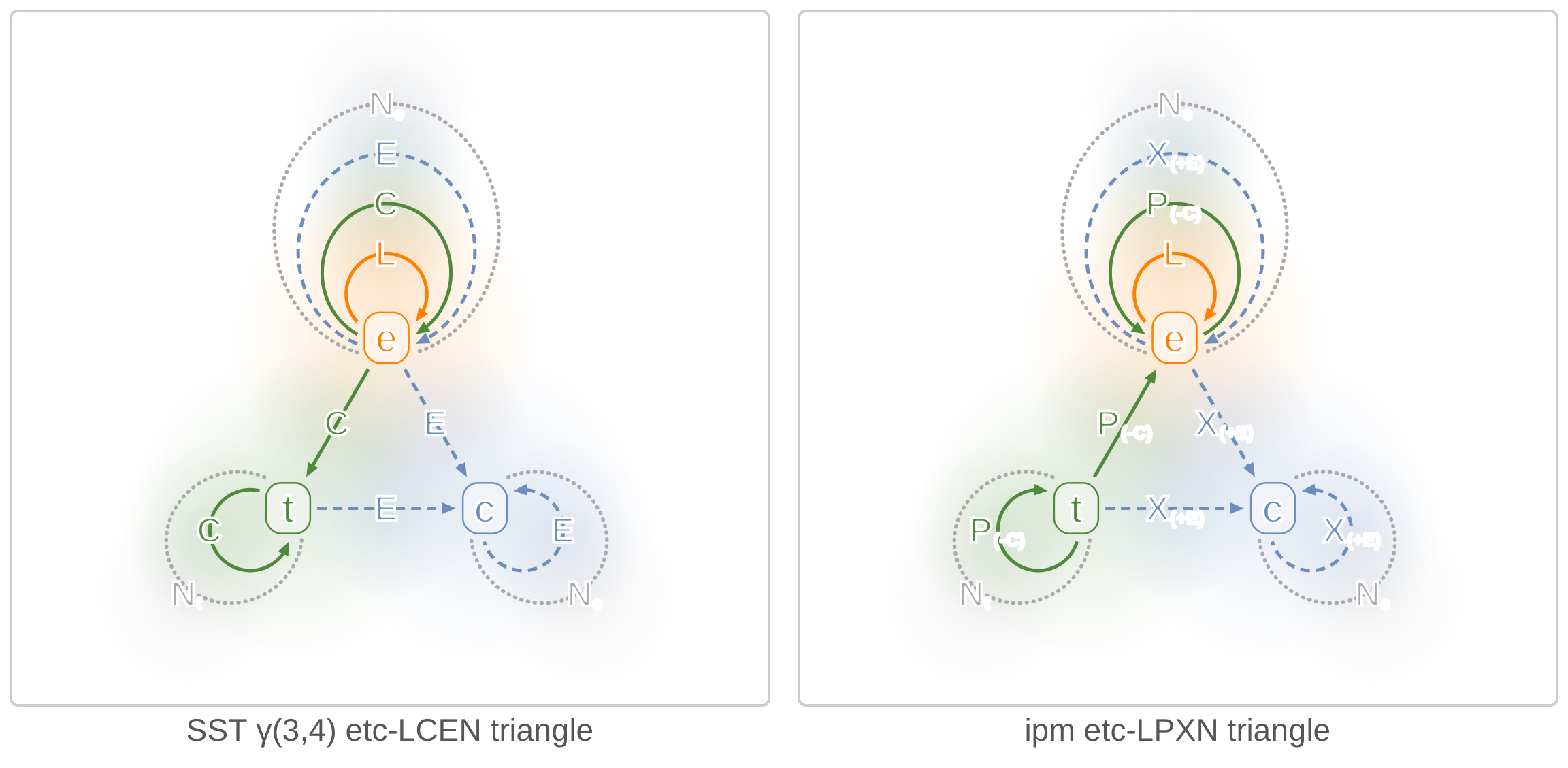
car --C--> engine - the car spatially encloses the engine) becomes IPM's part-of (engine --P--> car). Containment in SST is a spatial property - a ring drawn around a region, not a generic hierarchy. The graph is the same; we prefer "part-of" because it reads naturally for participation ("Patrick is part of the swap event"), and the arrow then points from the small thing toward its larger spatial container.E next to e is easy to mis-read; X next to e is not.)L (leads-to) and N (near-to) keep their SST names. So the IPM mnemonic for the four edges becomes LPXN, in place of SST's LCEN.
Both panels draw a same-kind relation between a corner and a second node of that kind (e and e2, and so on)
rather than as a loop back to the corner itself: an event that leads to an event leads to a different event.
Only the labels and the C/P arrow direction differ between the two panels; the geometry is identical.
Mark states the allowed transitions as a matrix: Agent Semantics, Semantic Spacetime, and Graphical Reasoning (arXiv:2506.07756, June 2025), §4.1 "Matrices for γ(3,4) skeleton", equation 21. Rows are the source node kind, columns the target:
| source → target | → e |
→ t |
→ c |
|---|---|---|---|
e |
±L, ±C, ±E, N_e | +C | +E |
t |
-C | ±C, N_t | +E |
c |
-E | -E | ±E, N_c |
The signs are directions, not different relations: +C is contains, -C is the same relation read from the other end, and N is undirected. Count each relation once and the matrix gives exactly the eleven edges IPM allows:
Count each relation once - the c → e and c → t cells are the reverse readings of e → c and t → c, not edges of their own - and the matrix gives exactly the eleven edges IPM allows. So IPM changes the labels, never which edges exist: the eleven combinations are Mark's, one for one. Each transition with its ipmt syntax, in both directions, is tabulated in ipm-tools/docs/sst-gamma34.md.
This is also what (-C) and (+E) mean on the triangles above. IPM's part-of is SST's C taken in the -C direction - from the part towards the whole - and IPM's expresses is SST's E in its +E direction.
semantic.st project home for the broader SST framework.